The Malays and Malay workers of Telok Blangah


Lately I have been sharing several posts about the houses of Telok Blangah; the palaces of the Temenggong, the colonial Black and White houses built for British colonials and their domestic staff, and those built by a Chinese towkay. But of course, the area wasn’t only inhabited by opulent Malay rulers, wealthy colonials and rich Chinese. Like in any neighbourhood, most of the inhabitants of Telok Blangah would have been middle class or not that well-to-do. In this post I zoom in on a particular part of Telok Blangah around Pender Road, to see who else lived here besides those in the illustrious Black and White Houses it is now famous for.
From the 19th century until well into the 20th century Telok Blangah was dominated by Malay kampongs, most of them inhabited by followers of the Temenggong. When the Temenggong moved to Johor Bahru, some followed him, but others stayed on in Singapore, and many more moved to the area, often to work in the harbour and adjacent industries. Malay houses were usually made of wood and raised on stilts, for additional ventilation, and to protect inhabitants against pests, floods and the tides or swamps when built on the coastline. The larger ones built by affluent owners often had beautiful styles and wood carvings. Roofing would be made of attap (palm leaves) or later zinc plates rather than tiles. Unfortunately, the Malay kampong houses of Telok Blangah have long been demolished. But if you look in the archives you can find design drawings of several such buildings, giving us an idea of what they looked like and who built them.


What is interesting when studying these Malay style houses, is that it becomes clear how much the colonial houses on Pender Road were influenced by them. If you imagine these houses without their characteristic black and white colouring, they suddenly look a lot like Malay houses. The junior electrician bungalows at number 1, 2 and 4A Pender Road are similar to simple kampong houses raised on stilts, and the larger ones at number 3 and 5 have the wraparound verandas and intricate woodcarvings that the wealthier Malay favoured. The architecture of colonial houses is often considered European but in reality, it was a fusion style strongly influenced by Malay architecture, not only because it looked good, but because these types of buildings were much better suited to the climate. The later concrete Black and White houses built by the PWD (Public Works Department) were a modern, simplified version that no longer had the wooden upper floors and woodwork, but maintained key features like the upstairs verandas which are so typical of Malay architecture.

Digging through the archives I came across several designs showing other types of dwellings in Telok Blangah, including many for ‘Malay coolie lines’ or 'Malay coolie quarters'. Usually we associate coolies (manual workers) in Singapore, with Chinese or Indian immigrants, so it is notable that in Telok Blangah most labourers in the early 20th century Keppel Harbour were in fact Malay. These particular ‘coolie lines’ (or staff housing) shown below were built in 1911 by the Telegraph company, between Pender Road and Wishart Road, on the spot where the Foresta condominium now stands. The design shows a courtyard with surrounding rooms and shared bathrooms and facilities.

They would have been inhabited by single men, and I would be interested to know whether the rooms were individual or shared. Comparing these simple quarters to the spacious colonial houses on Pender Road built by the same company for their European managers, one can’t help but feel the vast gap in comfort and space. On the other hand, comparing them to the current dormitories that migrant workers inhabit, makes one wonder whether these coolie lines with their outside courtyards and separate rooms might have been more comfortable than their modern counterparts.
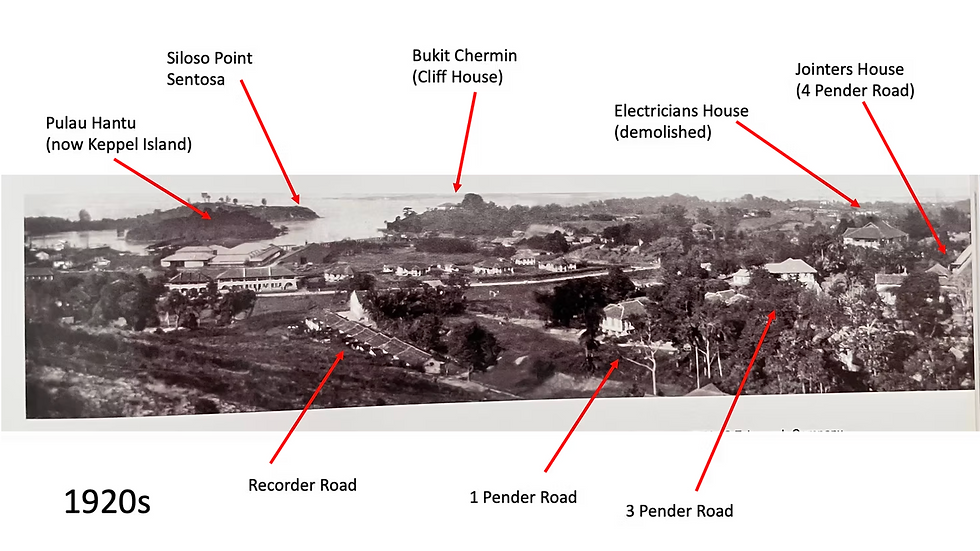
Others inhabited the space in between the European managers in their villas and the labourers in their coolie quarters. An interesting example of middle-class residences are the terraces that were built along Recorder Road by Ang Seah Im in 1907. They were labelled ‘dwellings’ and are humble homes, likely rented out to junior staff at the harbour and their families. The design is quite pretty, fronted by columns, and here too we see indoor plumbing. The dwellings are small but comfortable, consisting of two rooms, a bathroom and kitchen. And they had an indoor bathroom and toilet, which would have been a luxury in those days.

A couple of decades later the Recorder Road dwellings were demolished, and the road name became obsolete. New workers accommodations were built in its place in the 1950s and 60s: 16 blocks of two-story flats for employees of the Singapore Harbour Board (SHB), who already had houses for its management at nearby Seah Im Road. Upstairs were living quarters, but the ground floor of some blocks had restaurants and a barber shop. And one of these blocks still stands at 16 Morse Road!

There is an Indian coffee shop here serving delicious prata, a reminder of a whole community of SHB workers that lived and worked here once. The other 15 blocks were demolished recently, and for now the terrain remains undeveloped and overgrown, offering an entryway into the wild nature trails sloping up Mount Faber. Now a quiet road fringed by churches, Wishart Road used to be a lively and self-sufficient community, a popular hangout for residents as well as people from nearby kampongs.

Not all Malay in the area were workers, many were home owners as we saw above in the designs for the Malay Kampong houses, and some were even property developers. An example of that are these 5 shophouses below that were built along Telok Blangah Road by Inchay Awang in 1907.

We can find more evidence of the Malay communities around the foothills of Mount Faber in the archives. In 1907 an attap-roofed wooden building was constructed to serve as the club house for the Babul Khairat Football club, located at Pender Road near the coolie quarters.

Where the British colonial houses in those days mostly featured tennis courts, and their inhabitants played golf, cricket, tennis and rugby at their clubs, football was a popular sport amongst the Malay. We can find more on the Babul Khairat club in the newspapers, like this article showing them participating in the famous Tramway cup in 1911, where they got beaten by the Marine Police team.

The archives proved to be a treasure throve of other surprising information: in 1908 Ang Seah Im built a cattle shed on the hill just west of Pender Road, which included accommodation for syces, the grooms, which were often Indian but here could also have been Malay. There were horse stables along Pender Road itself for the carriages, again with living spaces for the syces included. The horses were used for transportation, and the dairy farm presumably to supply milk to the families living in the area. There were other such cattle farms run by Malay owners down the road towards Pasir Panjang.

In 1907 a ‘new’ market was built, and further extended in 1909, a hexagonal cast iron construction in art deco style, at the crossing of Morse Road with Telok Blangah Road. Likely an earlier market would have operated in the open air or under an attap roof. It would have served the Malay kampongs as well as the domestic staff of the colonial houses. In a 1944 map we see a modern development: a Cold Storage supermarket has sprung up to supply the more well-to-do households – by now they would have had the fridges to store these items too as the area got electricity after St James power station opened in 1927 nearby.

Through these old maps, drawings and photos I have tried to piece together what the area around Pender Road looked like in the early 20th century. We like to admire its beautiful Black and White colonial villas, who thanks to their impressive architecture got preserved, and rightly so. But it is important we also remember the more modest workers dwellings, the Malay kampong houses, all those places where the local people and immigrants lived who were instrumental in the building of Singapore and New Harbour: its roads, its buildings as well as its communities. Like the migrant workers of today, they are rarely visible in the buildings and stories we choose to preserve and share. But without these workers, no work would have ever been completed. They were often undervalued, underpaid and at times exploited and demeaned. By remembering their stories, I hope we can celebrate them. And, like block 16 Wishart Road, let’s hope we can preserve at least some of their homes next to the grander buildings they built and maintained for their bosses.
Sources:
Maps all come from the National Archives of Singapore: https://www.nas.gov.sg/archivesonline/
Building drawings also come from the National Archives, but have to be seen in person as they are on microfilm.
Newspaper clippings to be found at: https://eresources.nlb.gov.sg/newspapers
All modern photos by author


Comments