Singapore's colonial Black and White Houses: Pender Road

Updated: Nov 4, 2025
This is the next post in a series on the history of colonial Black and White Houses of Telok Blangah. The colonial houses in this area were built for expatriate staff working at Keppel Harbour, and the area was first developed by Chinese businessman Ang Seah Im, as we saw in this previous post. I want to show you another colonial estate on the foothills of Mount Faber, which is rather special as it was built as the first corporate estate in Singapore, and in fact predates most of the better know PWD (public works department) colonial estates built by the government, most of which date from after the second world war. Today I am going to tell you about Pender Road.

The name of the street gives away the background of the houses. It was named after John Pender, the founder of the Eastern Extension Telegraph Company. In my earlier post I mentioned property developer Ang Seah Im built two roads leading up the hill from Telok Blangah. On one he built his own mansion, and named the road after himself, on the other the Telegraph company would develop their new estate.
The Telegraph company had a depot and jetty in Bukit Chermin bay (where part of the Reflections condo stands now), as well as some houses for staff on a nearby hill called Bukit Ayam. (Bukit Ayam is located at the crossroads of Henderson Road, Telok Blangah Road and Bukit Chermin Road, and over the past few months it has been crawling with bulldozers slowly digging away the hill in preparation for new developments in the area. The colonial houses have been long gone, and the hill was part of Keppel Golf Course up until its closure a few years back)
The Telegraph company was responsible for laying the submarine telegraph lines all across the British empire, including its territories in South East Asia. In the early 20th century business was booming, and they expand rapidly. They needed more houses for their staff.

As the building plan above confirms, Ang Seah Im built Pender Road, yet unnamed, in 1907. The distinctive shape of the road winding around the foothills makes it easy to identify. In 1908 three houses are built on the road by the Telegraph company, one of which still exists.


The Jointers Quarters at 4 Pender Road was designed by Regent Bidwell of Swan & Maclaren, the famous architect responsible for many notable buildings of the era, including the Raffles Hotel and the Atabara House (now part of the Botanic gardens) which was built a decade earlier but shares similarities in style with the Jointers Quarters. The two other houses were the Electricians House and a bungalow for a Married Engineer. Both buildings have been demolished.

The jointers were bachelors and the house at 4 Pender has a unique layout. These days it is split in two family homes, but in the past a wooden veranda linked both halves. The house has an interesting design that is very different from later colonial Black and White houses and features quirky round windows resembling port-holes, possibly a nod to the nearby harbour? (The house is rented out, and one half is currently being renovated and should come up for rent soon, so if you are tempted, keep an eye out!)

The drawings tell us what the houses looked like, but in order to find out more what it was like living here in this era, some more archive digging is required, this time in the newspapers. The Straits Times tells us there had been some debate about water supply to the road. In 1908 it is mentioned a standpipe will be erected on Wishart Road at the cost of the Telegraph company, yet in 1910 there are still issues with the supply. What is also notable is that in both 1908 and 1910 mention is made of a ‘house’ on Pender Road, singular rather than plural.

It could be that either the newspaper made a mistake, that the water issues were only relevant for one of the houses, or that the remaining two houses were built later.

The next interesting piece of news that pops up is an article in 1916 that shows the land around Pender road going up for sale in a ‘mortgagees sale’. Possibly Ang Seah Im had merely leased his land to the Telegraph company in 1908, or this refers to other plots in the area still unsold. In the 1910s Ang Seah Im’s business started to go downhill and in 1914 he was declared bankrupt. He managed to get back on his feet initially, but was again in the bankruptcy court in 1922. One can easily imagine his financial problems forced him to sell of the remaining Morse and Pender Road land in 1916.

The first world war and the period just after, with a growing demand for tin, rubber and other items sources from this region, resulted in a building boom all over Singapore. Most of Singapore’s Black and White colonial houses date from this era, and the Pender Road estate was extended too. This design above is for 3 houses, unnamed but judging from the size of them built for married staff in higher management positions. Only two of them were built, in 1919, and both still exist (3 and 5 Pender Road respectively).

The houses are a classic example of a Black and White house and like the 1908 houses were designed by Swan & Maclaren, though their design is quite different. They have stone lower floors to keep the house cool at night, and a mostly wood upper floor to absorb the daytime heat. A wide overhanging roof keeps the rain and sun out. These houses mix the British mock Tudor style with arts and craft details, and a Malay influence is visible in its open galleries and elegant woodwork. Number 5 Pender Road is particularly interesting as its upper veranda still has all its louvred windows intact, whereas similar houses usually have all the shutters replaced by glass windows to allow for air conditioning.

Similarly the verandas leading to the bedrooms on the side of the house are still open to the elements, with the bedrooms leading straight to the outdoors. The house has ventilation vents throughout. This would not have been a luxury in those days. As we saw earlier, the Pender Road houses had water around 1910, but they would not be connected to electricity until after the nearby St James power station opened in 1927.
Having studied many colonial houses in Singapore I have become quite adept at guessing their age, not just from the building style but also from the number of air vents, which can tell you whether they were built before or after electricity was available. Availability of electricity depended on location, with the city centre being connected much earlier than the suburbs. I also have to note here that for many of the kampongs in the area, electricity wasn’t available until much later – it was only for rich people in those days.
Without amenities like electricity and modern plumbing, and all that woodwork to clean, you can imagine the colonial households employed a lot of staff, and fairly generous quarters were built for them, usually behind the house yet connected by a covered walkway. The staff quarters of 5 Pender Road has three bedrooms, a bathroom, and a separate toilet. The kitchen, being smelly from cooking on wood, was typically in the outbuildings though the main house would have a small kitchen or ‘butler’s pantry’ as described on the building design of this house.

I have heard living in colonial houses like this called ‘veranda living’ and this name is apt. Classically designed Black and Whites like this have both an upstairs and a downstairs veranda, with the downstairs one used to receive visitors, and the upstairs being more private, for family and intimate friends. In the evenings, with all the shutters opened and a breeze coming from the sea up Mount Faber, the upstairs veranda is a lovely place to linger.
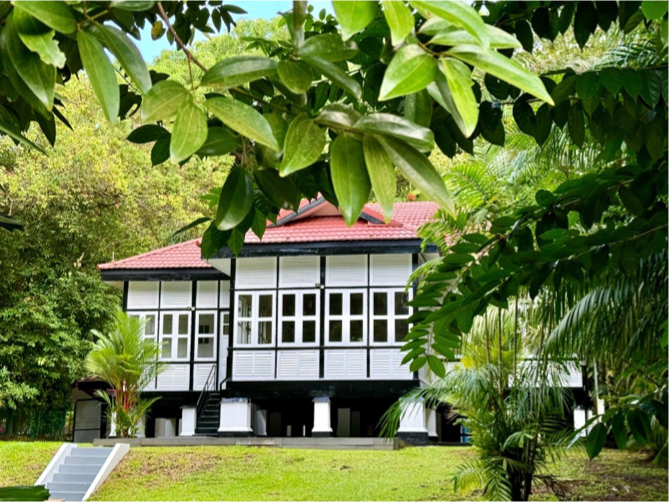
In the 1920s more houses were built on Pender Road, single story bungalows for more junior staff, called ‘small bungalows’ on their design drawing. Three of them still exist, nr 1, 2 and 4A Pender road now. They are of a similar design to the larger houses of 3 and 5 Pender Road, but have only a single story with two bedrooms in the main house. They are raised from the ground in the Malay style, to protect the house from pests and flooding. As can be seen in the photo above these houses have all had their shutters replaced by glass windows and the zinc roofs are now tiled.

To find out who lived in these houses we can turn to the newspapers. We find reports of break-ins, items listed for sale, and residents winning tennis and rugby competitions. Tennis was a favourite sport for early 20th century colonials, and several of the houses in Pender Road had their own tennis courts, some of them still used in the 1990s. In the garden of 3 Pender Road there is still a flat area where the court used to be. These days residents prefer swimming pools to tennis courts, and the area has become much more overgrown than it was initially and the houses had an uninterrupted view towards the sea.

In 1932 we again find something interesting: some of the houses at Pender Road are offered up for rent. With most of the Telegraph network built, the size of the company decreases significantly and less staff needs to be housed. The house at nr 5 has an asking price of 150 dollars per month, is fully furnished and comes with a tennis court and garage (which is no longer there). The smaller 2 bedroom bungalows at nr 1 and 2 are let for only 70 dollars but have a notable provision: Europeans only need apply!

Of course, in fact many non- Europeans lived on or around Pender Road, as house staff or in the workers' quarters (coolie lines) of the company. In a next post I will write more about them!

This map from 1944 gives a good overview of the Pender/ Morse Road estate just before WW2, with the Jointers Quarters at nr 4, the two large houses at 3 and 5, the Electrician’s house at nr 8, and the House for Married Engineer at nr 6. The 'small bungalows' are nr 1, 2 and 4A. This map also shows coolie lines along Wishart Road, terraced dwellings on Recorder Road, a wet market and even a Cold Storage Supermarket that has sprung up by now to serve the expat community in the area.

By 1959 we see some changes yet again. The terrace at Recorder Road has been demolished and replaced with new accommodations for workers, the SHB flats housing Singapore Harbour Board staff. One of these blocks still exists on Wishart Road now. The two houses at 6 and 8 Pender Road are still there, and an additional apartment block has been built at 7 Pender Road.


In 1978 both 6 and 8 Pender Road are gone, and an additional block of apartments is added at 9 Pender Road. There are still a number of old colonial house on the other side of Telok Blangah Road, including the old Bukit Ayam estate which has since been demolished. Another thing to note is that by now Telok Blangah Hill has been blasted in two, and Henderson Road has been extended. Pender Road, which used to lead all the way to the Alkaff mansion on the top, is cut off and a new loop around the top of Mount Faber is created.

With all the new developments, particularly on the area where Keppel Golf Course was until recently, we can only guess what the area will look like in another decade time. Let's hope many of these historic houses can be preserved, as they offer a unique glimpse into live as it was in the past.
Sources:
Maps all come from the National Archives of Singapore: https://www.nas.gov.sg/archivesonline/
Building drawings also comes from the National Archives, but have to be seen in person as they are on microfilm.
Two books by Julian Davison have a lot of information on the history of the Black and White houses of Singapore:
Swan & Maclaren: A Story of Singapore Architecture
Black and White, The Singapore House 1898-1941
Newspaper clippings to be found at: https://eresources.nlb.gov.sg/newspapers
All modern photos by author


Comments