Amahs, houseboys, cooks, syces and kebuns – how did the domestic staff of Singapore's colonial estates live?

When we talk about colonial Black and White Houses in Singapore and their inhabitants, we tend to remember the British families that lived in them. In reality a colonial estate would house many others besides the tuans besar and their families, and they can be roughly divided into two categories: domestic staff and company workers. In this post I want to talk about that first group. You can imagine those large houses with all their timber, like the ones I describe in my previous post on Pender Road, took a lot of effort to maintain, especially without electricity and other modern conveniences. The domestic staff of a large house could consist of more people than the family it served. And many of these staff, or servants as they were called then, lived in with their employers, in adjoining ‘servant quarters’.

The size and style of accommodation available to certain groups tells us a lot about their standing in society. In modern Singapore many still employ help around the house, usually a single live-in domestic worker, and the accommodation she is offered is often limited. From a windowless bomb shelter in a condominium to a small space in an HDB flat – even large modern multi-story houses sometimes confine the ‘helper’ to a few square meters behind the kitchen. How were the colonial domestics housed? Let’s try to find out who they were, and in particular what their accommodation looked like in a bit more detail.

In the 19th century colonial households in Singapore usually employed a ‘house boy’ or ‘boy’, typically from China. He served as a man of all jobs, and depending on the wealth and size of the household a Chinese cook could be hired as well.
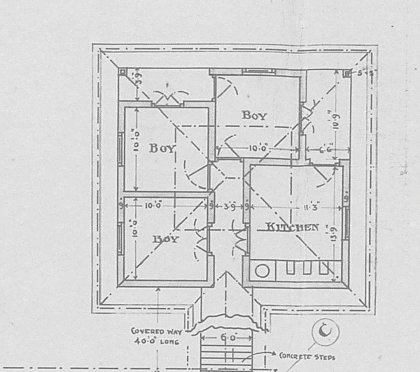
This image above shows the staff quarters of 4 Pender Road, built in 1908 for jointers, bachelors working for the Telegraph company in Keppel Harbour, the company that built the Pender Road estate from 1908 onwards. It has rooms for 3 different ‘boys’ surrounding a kitchen. The design for the outbuildings of the much larger Electricians House next door shows similar outbuildings with 3 rooms for a 'boy'. This shows that in those days the norm was still to employ male domestic servants.

The image above from 1907 is another example of an early Black and White House's outbuildings, or ‘cook house’. Cooking was done on wood fire, and since that created a lot of smoke the kitchen was in the outbuildings and you can still recognise these by their chimneys. This 'cook house' has a kitchen with a single adjoining room as well as a toilet. The front of the building has a small porch, and it is connected by a walkway to the main house – one wouldn’t want the food to get wet in one of Singapore’s torrential rains.
In the 20th century the setup of European households started to change. With travel becoming safer and easier, more wives followed their husbands to the colonies, which meant more children were born here as well. The domestic staff changed and female servants started to replace the houseboys.

The photo above shows the outbuildings of 5 Pender Road, built over a decade later in 1919. The first room on the left is the main kitchen, as can be seen from its chimney, and notable here is a second chimney on the right. On the design this nook is labeled a ‘Malay dapor’ – dapur is the Malay word for kitchen, so this likely would have been a kitchen for the staff. There are three bedrooms, a bathroom and a toilet. Even though it may seem large to today’s standards, do bear in mind these outbuildings housed multiple staff.
Who could have lived here?

In the 20th century a new type of servant became popular: the amah. The word amah refers to a nanny - the word comes from the Portuguese ama which means nurse, but the amah later became a key figure amongst the domestic staff doing different jobs besides childcare, akin to a housekeeper, and similar to domestic workers today. And where contemporary domestic workers usually come from the Philippines, Indonesia or Myanmar, these amahs came from China and were also called ‘black and white amahs’, or Cantonese amahs. The name doesn’t refer to the houses they worked in, they worked for all kinds of families in Singapore, but to their distinctive black and white samfu outfit. Although they usually lived in the servants’ quarters of their employer’s house, there are other buildings to be found in the area that can teach us more about their lives.

Just around the corner of Pender Road, on Henderson Road, sits an interesting little temple: the Koon Seng Ting Temple. It dates to the late 19th century and was founded, or possibly extended, by a Teochew woman called Teh Chit Yee who started a vegetarian eating hall for majies here. Majie (or Mah Cheh in Cantonese) means mother or sister, and the majies were a group of women that came to Singapore from the region of Shunde. The majies took a vow of celibacy, organised themselves in sisterhoods and, fleeing poverty in China, came to Singapore to work, particularly after men were restricted to do so in the 1920s. Many majies worked as domestic workers and they became known for being the best amahs available. They raised many children in Singapore up until the 1970s. Many worked in the colonial houses around Telok Blangah and would have visited the Koon Seng Ting Temple. The temple is dedicated to Guan Yin, the goddess of Mercy, and it is still mostly visited by and attended to by women. Its pink façade offers a striking contrast to the new HDB flats behind.

Not all the staff lived with their employers, and although some lived in the surrounding kampongs, there were also other dedicated buildings for domestic staff.

In 1908 the Telegraph company built the ‘Kabun’s Quarters’ pictured above. Kebuns were gardeners and often Malay – the word kebun means garden in Malay. The building is made of wood with an attap (palm front) roof and seems to be more basic than some of the other servants quarters, and unlike the cook’s house and domestic outbuildings it does not seem to have a toilet.
Another important staff member was the syce. Syce is a term that came from India and means groom – the syce attended to the horses and later when cars became more common functioned as a driver. Many syce were of Indian origins, but they could be Malay or Chinese as well.

A syce usually lived in the stables, as the image below shows. These particular ones were built buy the Telegraph company in 1911 and shows stables for three horses, a space to store the carriages and three rooms for syces. It boasts an outdoor latrine and bathroom and a small kitchen inside.

A 1919 plan for a garage by the Telegraph company shows no built-in accommodation. Likely the car was driven and maintained by its owner.
Apart from cleaning the house, maintaining the garden, cooking and minding the children, buying groceries was another job for the domestic staff.

The cast iron structure shown here looks like a smaller and simpler version of the famous Lau Pa Sat market in Telok Ayer, and this wet market was located on the corner of Morse Road and Telok Blangah Road, where the Grace Methodist church now stands. It was extended in 1909 and would be a place where domestic staff went daily to get fresh produce. In a 1944 map we see a modern development: a Cold Storage supermarket has sprung up next to the wet market to supply the European housewives with their cravings for imported goods – by now they would have had the fridges to store these items too as the area got electricity after St James power station opened in 1927. This would have made lives a lot easier for the domestic staff, and this is reflected in the amount of people typically employed.
Looking at these accommodations of domestic staff we can try to imagine what their daily lives looked like. Like the migrant domestic workers of today, many of them played an important role in the lives of those they worked for. During all of history domestic workers have been undervalued, underpaid and at times exploited and demeaned. They still are today. By remembering their stories and the places they lived in I hope we can celebrate and remember them. Let’s hope we can preserve their historic homes next to the grander buildings they took care of for their bosses.
All building designs from the National Archives of Singapore.
Further reading on domestic staff in colonial times:
Picture credits:
Servants of an European Resident: Courtesy of the National Library Board)
Chinese Houseboy: Photo by G. R. Lambert & Co., 1890. Courtesy of the National Museum of Singapore, National Heritage Board)
Chinese Amah: Courtesy of the National Museum of Singapore, National Heritage Board
Black and White Amah with child. Photo by Gavin G. Wallace. PAColl-2480. Alexandar Turnbill Library, Wellington.
Carriage and syce. Courtesy of the National Museum of Singapore, National Heritage Board.
All modern photos by author.
To learn more about the current situation of migrant domestic workers in Singapore visit: www.home.org/sg. HOME is a local charity supporting migrant workers in Singapore.


Comments