Istana Woodneuk: Can the dilapidated royal palace in the Singapore jungle be saved?

Updated: Sep 15, 2025

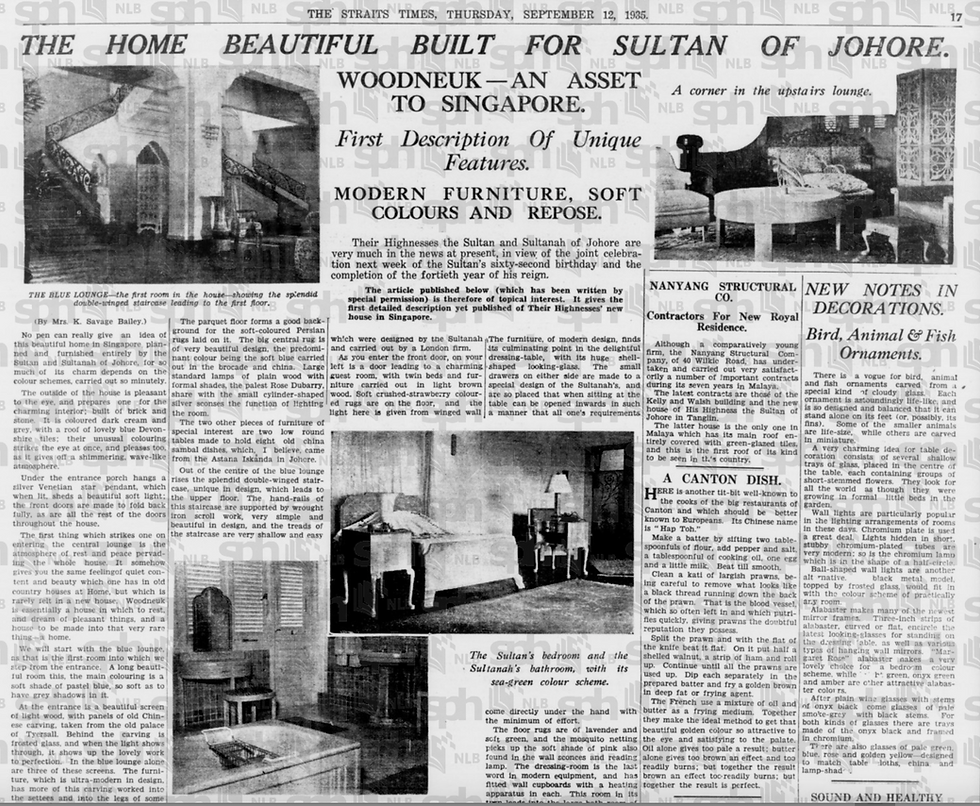
'Woodneuk - an asset to Singapore' is the headline of an article in the Straits Times on September 12th 1935. It goes on to describe the features of the newly opened palace: modern furniture, soft colours. "No pen can really give an idea of this beautiful home in Singapore, planned and furnished entirely by the Sultan and Sultanah of Johore, for so much of its charm depends on the colour schemes, carried out so minutely."


It's a shame the accompanying photos are in black and white, but the article still gives us a impression of what Istana Woodneuk must have looked like in its heydays. When we now walk around its crumbling walls, the wrought iron balustrades overgrown with creepers, through the shards of the bright blue roof tiles scattered around, we can close our eyes and try to bring back the past. We can imagine the parties held here, that were some of the best in the colony. We can image the guests, Malay, British and foreign alike, that graced these halls in their finery. Istana Woodneuk might not have been the Sultan's main palace, it is simple compared to its grander neighbour the Istana Tyersall with its magnificent ballroom, and the older Istana Besar across the Strait in Johor, but it was still a remarkable residence that hosted many dignitaries in its days.
Last week the old Istana Woodneuk was in the news again, after Singapore announced a land swap with the Johor royal family for parts of the Tyersall Estate, next to the Botanic Gardens. The plot that the Istana Woodneuk sits is now in Singapore's hands. Personally I feel strongly that the old Istana Woodneuk deserves to be restored and preserved, as do many heritage enthusiasts with me. Even though it is not the most illustrious of the old royal palaces, it is the only one that has not yet been demolished. And it does have some rather intriguing stories of its own. Let me take you back in time as I try to recreate the story of Singapore's unique, some say haunted, royal palace in the jungle.
Woodneuk's fascinating history starts in the days of Temenggong Abu Bakar, and if you don't know who he is, I recommend you read my previous post on the Temenggongs of Singapore here first.

The first Woodneuk House was built by a Scotsman, Captain Dill Ross, somewhere in the 1850s. It isn't clear when the estate was obtained by Abu Bakar, but a 1892 newspaper article mentions it as 'recently acquired' so we can assume it was sometime in the years before. Abu Bakar had bought the adjoining Tyersall estate from lawyer William Napier in 1857 and made it his main residence. The Tyersall House was already one of the finest in Singapore, but after Abu Bakar gained the title of Sultan of Johor in 1886, he needed a palace to match. In 1866 he had built the Istana Besar in Johor, but being born and bred in Singapore he still considered it his home and he spent much of his time there. As the seat of the government of the Straits Settlements, Singapore was also the place where most important British dignitaries resided. Abu Bakar played an important role in the fledgling city state, by governing Malay affairs and acting as a liaison between the British government and the other Malay rulers in the region.
In 1890 Abu Bakar tore down Tyersall House to build a new palace that would be the finest of the region, the magnificent Istana Tyersall. But that is a story for another time, today I want to tell you about its little sister, Istana Woodneuk. He likely bought it to use as a temporary residence to stay whilst construction was ongoing, and to add acreage and a second dwelling to the larger Tyersall estate. Unfortunately I have not been able to find old photos of Woodneuk House, and it is not clear whether Abu Bakar kept the old house as it was or made significant adjustments.

The name Woodneuk was maintained, and it is one that has mystified many. Me in particular, as in Dutch 'neuk' has a rather lewd meaning. In Scottish it simply means corner, similar to the word nook in English, but when I learnt that Captain Dill Ross had grown up in Batavia, had sailed on Dutch East Indiamen and spoke fluent Dutch, it did make me wonder if the pun was intended. (if you are wondering too, you might have heard of 'doing nookie' in English slang, it means the same thing...) During the 1860s - 1880s Woodneuk house was advertised for rent several times, was used for social events and several births took place there. By the 1890s it definitely was owned by Abu Bakar. In several articles it is mentioned as being used as a guest house for the main palace in Tyersall, and as part of the large estate and gardens. In 1894 the Sultan Ahmad of Pahang resided in Istana Woodneuk for some time, there was an uprising of local chiefs against British rule in Pahang and he was banned from staying there. Both Malay rulers seemed on good terms by then, despite Abu Bakar's earlier support for Sultan Ahmad's brother and rival Tun Mutahir in the Pahang civil war. Tun Mutahir too had settled in Singapore near Telok Blangah, in what became known as Kampong Pahang. In 1897 Sultan Ahmad's son and successor Tun Mahmud would marry Abu Bakar's daughter princes Mariam.


When he died in 1895, Abu Bakar left the house to his widow and fourth wife Sultana Khadijah, who in her turn left it to her stepson, the new Sultan Ibrahim. Sultan Ibrahim didn't spend much time in the city of his birth, he liked to travel and lived a playboy lifestyle. He was born in 1873 in Istana Bidadari from Abu Bakar's second wife Encik Zubaidah, born Cecilia Catherine Lange. She was of mixed descent, her Danish father was a merchant in Dutch Bali with the appropriate nickname 'King of Bali' and her mother his second wife, nonna Sang Nio, of Chinese heritage. So young Ibrahim was of mixed descent and raised between different cultures. He was sent to England for his schooling, making his English and European manners even more impeccable than those of his father. He mostly got along well with the British and many of the Royal houses of his time, and must have been a remarkable and charming character. In other ways he was thoroughly a Malay royal, and as such had many wives. He also had a reputation of being a womaniser and an Anglophile with a taste for European women. And that is where our story brings us back to Istana Woodneuk.

Unlike his father, Sultan Ibrahim didn't spend a lot of time in Singapore, but in the early 20th century the Istana Tyersall was still used for official events hosted by him, like a Gymkhana in 1900, and the Sultan’s Ball to celebrate his 29th birthday in 1902. In those days there wasn't such a clear division between Singapore and Johor, and Ibrahim will have considered both places his homeland. In 1904 a goodbye party was held at Tyersall for Johor princes and sons of notables that were sent to Britain for their schooling. It is harder to find reference to Istana Woodneuk in these years, though two births are registered there: that of the son of famous architect Regent Bidwell and the daughter of a James Campbell of Johor. Could he be a relative of Douglas Graham Campbell, a civil servant who was appointed General Advisors to Johor in 1910? Did the Sultan rent out Woodneuk House or did he let select guests stay there? The archives and newspapers don't say.


In 1905 disaster strikes and a fire destroyed a significant part of Istana Tyersall, in particular its renowned ballroom. After this, the whole estate, including Istana Woodneuk, became neglected. Despite Sultan Ibrahim being tremendously wealthy, particularly after the rubber boom of the early 20th century, he didn't seem to prioritise rebuilding his Singapore properties. Until 1930, when he married his fourth wife Sultana Helen. Helen Bartholomew was born in Glasgow in 1899 and in 1914 had married Malayan born doctor William Wilson in Singapore, who was the physician to the Johor royal family. After they divorced and she moved to London she got close (again?) to Sultan Ibrahim. After their marriage the Sultan took her back to her beloved Singapore in 1932 and agreed to built her own, brand new palace, on the site of the old Woodneuk House.

The new house was designed by Irish architect Denis Santry of the prestigious firm Swan & Maclaren, who built several of Singapore mansions and landmark buildings of the era, including Sultan Mosque in Kampong Gelam. As an architect he was influenced by the Arts and Crafts movements, and as his design of the Indo-Saracenic styled Sultan Mosque shows, he liked blending oriental and western influences to create dreamlike buildings that seemed to come straight out of Scheherazade's 1001 nights. Building a palace for a Scottish - Malay Sultana must have been a dream job and he did it fabulously. Istana Woodneuk was to be a modern home, yet fit for a Sultana. One of the reasons for its hotchpotch style could be the strong involvement of the Sultan and Sultana, which resulted in a curious style that mixes Art Deco, Spanish Missionary as well as Chinese and Malay elements. It's buttressed walls and wrought iron railings give it a solid yet elegant look. The crowning glory of the new Istana was the roof, tiled in bright blue Devonshire tiles, which together with the red tiles of the Istana Tyersall are the colours of the Johor flag.


As the article mentioned above by Mrs Savage Bailey states, colours were the big attraction in the interior as well, all hand-picked by the Sultana herself. The main reception room, the blue lounge, was 'a soft shade of blue, so soft as to have grey shadows in it'. The furniture was ultra-modern, 'upholstered in a pastel-blue brocade.' The dining room on the other hand was 'a study in fawn brow and green.' The polished parquet floor was covered in both Persian and Chinese rugs. Some of the old decorative elements were taken from the neglected Istana Tyersall, like the Chinese wood carved panels at the main doors.

Istana Woodneuk was very different from the grand Istana Tyersall next door that was designed by Abu Bakar’s wife Sultana Fatimah of Chinese descent, and that was meant to impress and dazzle visitors. Istana Woodneuk had neither a ballroom, nor a grand dining room or many guest rooms. Sultana Helen wanted something very different, and of a much more modest size. The Istana Woodneuk was designed to live in. Or, as Mrs Savage Bailey says: “It somehow gives you the same feeling of quiet content and beauty felt in old country houses back home, but which is rarely felt in new houses. Woodneuk is essentially a house in which to rest, and dream of pleasant things, and a house to be made into that very rare thing: a home.”
Tragically, Sultana Helen would not enjoy her dream home very long. Another blue-eyed girl had caught the eye of her Sultan, dancer Lydia Cecilia 'Cissy' Hill, and they had a whirlwind romance. Cissy was an English girl through and through, and for her Sultan Ibrahim built a 'palace' in her hometown in Kent. She was killed by German bombs in 1940, and we will never know whether Ibrahim intended to marry her. He and Helen divorced in 1938, apparently amicably, but she did move back to the United Kingdom after.
Sultan Ibrahim married Romanian Marcella Mendi shortly after he met her in London in 1940 and the couple made the new Istana Bukit Serene in Johor, the construction of which was completed in 1939, their main residence. Istana Bukit Serene has some features that remind of the Istana Woodneuk which was built just a few yers earlier, and boasts a 35m high tower that looks across the Tebrau Straits to Singapore. Sultan Ibrahim never really forgot where he came from.


What happened to the Istana Woodneuk? Before and during WWII it was used by the military, amongst others as a hospital. After the war it became the residence for military commanders-in-chief like Sir Miles Dempsey, and in 1947 governor general Malcolm MacDonald stayed there. In 1948 it was returned to the Sultan of Johor. And after that its story goes quiet, apart from the odd mention in the news. In 1954 the royal family got a grant to repair the roof, and in 2006 it was badly destroyed by a fire. The roof collapsed and the pretty blue Devonshire tiles now lie broken and scattered across the land.
The tasteful pastels of Sultana Helen have been replaced by the bright neon hues of graffiti mixed with dark soot and mould. Instead of featuring potted ferns and palms the whole house is overgrown with lush green, creepers and vines. The once magnificent manicured lawns have been reclaimed by the jungle. The house sits and waits to be completely overwhelmed by the tropics. Only teenagers, adventurers and heritage enthusiasts sneak into the house to witness it gradual decay.

And now, the plot of land is owned by the Singapore goverment and the question arises: what will happen to it? The western and middle plots of land where the famous Istana Tyersall once stood, are zoned to residential use and may be developed by the Johor royal family. It likely won’t be long before condos and luxury apartments will rise on the ruins of the old Istana Tyersall, and we can only hope it will be done in a tasteful way which will keep its memories alive.
So how about the plot that holds the Woodneuk house? It is zoned for special use, that means it cannot be built on. It will most likely be added to the Botanic Gardens eventually. Will it be possible to restore and preserve the Istana Woodneuk? As the only one still standing of the Temenggong family royal palaces, it is an emblem of Singapore past, and a reminder of the time when Malay royals ruled the island still. The building could become a heritage gallery telling Singapore’s Malay history and how the Temenggongs were instrumental not only in the development of the State of Johor but that of Singapore as well.
60 years after independence, the myth that Singapore was a fishing village before the British arrived has still not been effectively debunked. In several comments on the news about Singapore acquiring this plot of land people suggested that the house has no historical value, as the family that built it were 'foreigners'. The son, grandson and great grandson of the Malay ruler of Singapore, who negotiated with Farquhar and Raffles about allowing a British settlement, all of whom were born here in Singapore and were instrumental to the development of Singapore in the 19th century, are considered ... foreigners.
For over a millennium, Singapore and Johor were part of the same country, the Malay Maritime Kingdom, a kingdom that ruled the seas of the archipelago and traded its items across the region and far beyond. The story of this Malay Kingdom is Singapore’s history too. The Malay Temenggongs of Singapore played an important role, and their story deserves to be told.
Sources:
I have been exploring Singapore history and studying the Temenggong family for years, and it would not be possible for me to highlight all my sources, but I do want to mention some important ones that are also the source of the older images in this article. Modern images are my own.
Swan & Maclaren - A story of Singapore architecture by Julian Davison


Comments